
What is a leader? Advice on choosing a leader for lure fishing

What is a leader?
Lure fishing is an active style of fishing that requires the angler to react quickly, forcefully and decisively. At the same time, the tackle must be of the highest standard: particularly the leader. So, what is a leader?
Leader: a technical term used to refer to the section of monofilament line attached to the braided line (also known as the main line) spooled onto the reel of a rod commonly used for lure fishing.
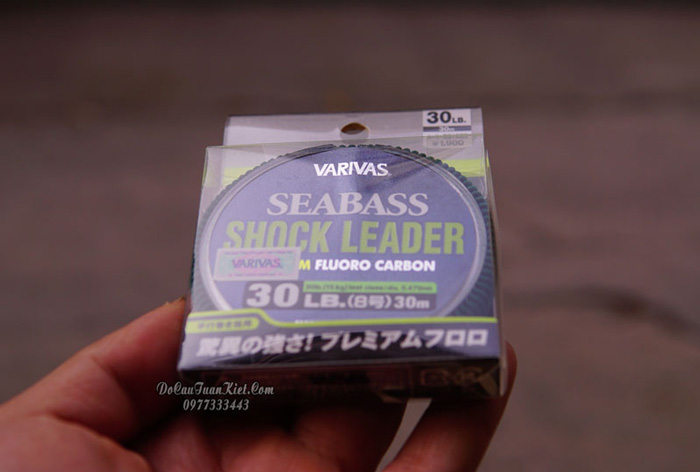
The renowned Varivas Seabass Shock Leader from Japan
The leader is also known by various other names, such as: tip line, short leader, or link line (for single or multiple hooks), and is typically made from high-abrasion-resistant fluorocarbon line.
Position of the leader: it is located at the front end of the main line and in front of the lure.
What is the purpose of the leader?
The leader line fulfils several important functions; it helps to address the shortcomings of braided line. At the same time, it protects the braided line and extends its lifespan. This type of line acts as a shock absorber, reducing the direct impact on components such as the rod, guides, reel and hook. This, in turn, helps to increase the durability of other parts of the fishing rod.

It prevents and minimises scratches to the main line when casting in areas with obstacles such as rocks, grass, water hyacinths and tree roots... This is an extremely important function of the leader.
What types of leader lines are there?
There are three main types of leader line commonly used: monofilament, fluorocarbon and fluorocarbon
1. Nylon leader line
Momo line is made from various materials, but its main component is nylon. It is characterised by being flexible, soft, highly elastic, and possessing good shock-absorbing and shock-resisting properties.
However, this is also the line’s weakness. Because nylon leader line is soft, it often becomes twisted into multiple loops whilst fishing, which affects the fishing process and is rather inconvenient for the angler.
Furthermore, nylon leader lines do not have a long lifespan; as the line is soft, it is prone to snagging and twisting, which over time leads to wear and breakage.
2. Fluorocarbon leader line
Fluorocarbon leader lines are composed of various compounds, notably carbon and fluorine. Compared to nylon, fluorocarbon leader lines are sturdier, offer superior strength, and do not suffer from snagging or twisting whilst fishing.
Another advantage of fluorocarbon is its invisibility when submerged in water. This encourages fish to bite more readily, providing anglers with a greater sense of excitement.
Overall, compared to nylon line, fluorocarbon line offers several superior features.
3. Fluorocarbon leader line
Fluorocarbon leader line is regarded by anglers as the best of the three types of leader line. Fluorocarbon combines the advantages of both monofilament and fluorocarbon lines.
Fluorocarbon line is soft, flexible and offers excellent shock absorption, yet it is also quite sturdy; it does not twist and is resistant to scuffing.
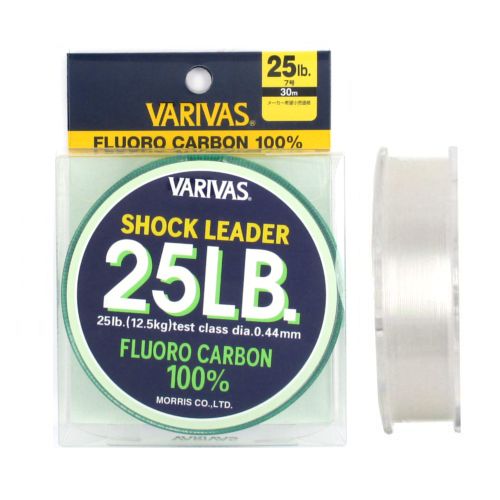
Fluorocarbon leaders also feature invisibility. A 3-in-1 product – fluorocarbon is truly the ideal choice for professional anglers.
Leader line for snakehead fishing
You should choose a snakehead fishing leader with a breaking strength of between 20 lb and 22 lb. The line should have a diameter of between 0.37 mm and 0.40 mm. Although snakehead fish are smaller than many other species, they are extremely aggressive. When they take the bait, they tend to thrash, jerk and thrash about violently. Therefore, you need to choose a sturdy snakehead fishing leader with the best load-bearing capacity, such as a fluorocarbon leader.
The two types of leader most commonly chosen by anglers today
1. Varivas Seabass Shock Leader
The Varivas Seabass Shock Leader is a renowned product from the Japanese brand Varivas. This type of leader is highly favoured by anglers in Vietnam and around the world.
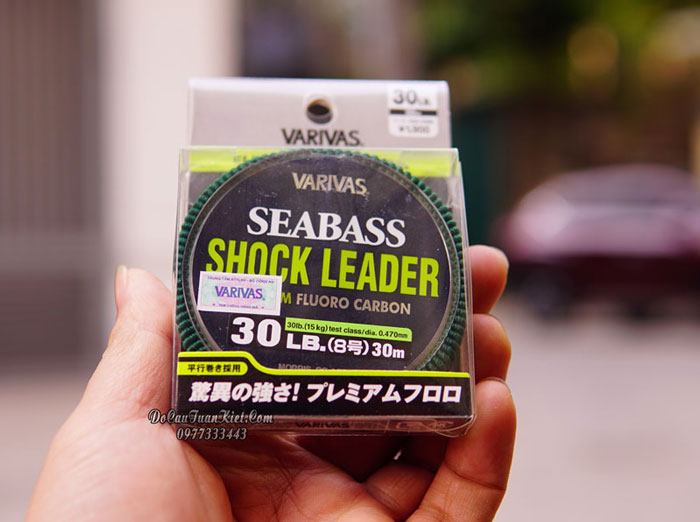
Varivas’s top-of-the-range leader line
The Varivas Seabass Shock Leader is available in a range of sizes and breaking strengths. The Varivas Seabass Shock Leader is 30 metres long, with diameters ranging from 0.260 mm to 0.470 mm. The line’s breaking strength is designed to be relatively high, ranging from 10 lb to 30 lb.
Varivas Seabass is suitable for many types of fishing, particularly lure fishing. Anglers can easily select the line best suited to their target species and fishing terrain.
2. Daiwa Fron Fune Harisu
The Daiwa Fron Fune Harisu 120m fishing line is manufactured by the renowned Japanese brand Daiwa. This line comes in a 120m spool. The diameter ranges from 0.235mm to 0.62mm. The breaking strength ranges from 10 lb to 30 lb.
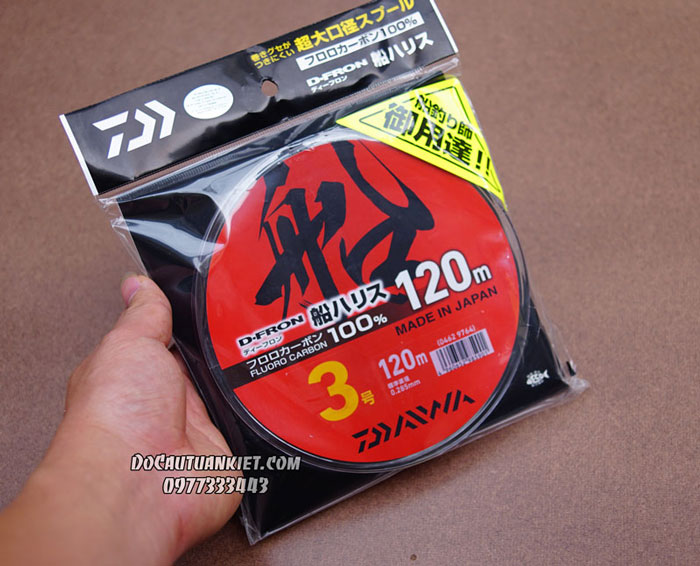
Genuine Daiwa Japanese leader line – view here
This is a transparent fluorocarbon line that is virtually invisible underwater, making it difficult for fish to detect the danger and encouraging them to take the bait. The Daiwa Fron Fune Harisu 120m fishing line offers excellent strength, shock absorption and is tangle-free. Consequently, when it comes into contact with obstacles such as rocks or floating debris on the water’s surface, there is no risk of the line being damaged or scratched.
With the advantages listed above, the Daiwad Fron Fune Harisu 120m line is truly the top choice for lure fishing trips.
Through this article, we hope to assist lure anglers in selecting the most suitable leader line. We wish you every success in becoming formidable figures in the Vietnamese lure fishing community.
Shop at Tuấn Kiệt’s store on Shopee:

How to tie a leader
There are many different ways to tie a leader. However, in this article, I will outline the most common and simplest method: tying an FG knot by hand. To carry out this method, you will need:
- Leader line
- A spool holding braided line
- Scissors
How to tie the knot:
Pull out a length of line, then fold it in half to about 25 phân. Wrap the folded section around the ring finger of your non-dominant hand, winding it around 4–5 times, leaving a small section free. Spread your index finger and thumb on your non-dominant hand, interlock them, and pull the folded section you’ve left free taut to form a triangle.
With your other hand, take the end of the leader line and place it beneath the taut line between your thumb and index finger. Leave a leader line segment of about 2 cm; use the thumb and index finger of your dominant hand to secure the leader line and begin winding.

Wind from the bottom to the left, then from the bottom to the right; then from the bottom to the right, and from the bottom to the left. Do this for 8 turns on each side (approximately 10–12 li) for the best fit. Whilst winding, keep the leader line taut so that the knot will be tighter and smoother.
Once you have wound 10–12 li, stop, hold the joint firmly, bite down firmly on the end of the leader line (leaving 1–2 fen before the joint) and pull hard. After pulling, the joints will retract to just 5 li and turn transparent as they are tightened together.
Once the joints have been tightened together, use the thumb and forefinger of your dominant hand to hold the joint firmly in place whilst releasing the braided line held in your non-dominant hand.
To secure the joint, take the short braided line and loop it once around the leader and the long braided line, then tie a knot. Use your hands to tighten both ends of the braided line whilst biting down on the end of the leader with your teeth and pulling firmly.
The long braided line should lie parallel to the excess leader. Take the short braided line and loop it over the leader and the long braided line to form a small circle, then wrap it around this circle five times in succession. Ensure that the fifth loop touches the first locking knot. Continue wrapping five more turns in this manner. Ensure that the sixth turn is tight against the fifth and lies on top of the first locking knot.
Once you have completed the next five wraps, flip the loop over and secure it with the thumb and index finger of your non-dominant hand. Position the excess end of the short braided line you have just wrapped so that it runs parallel to the leader and the long braided line.
Hold the three lines firmly with your dominant hand, whilst using your non-dominant hand to grip the loop and wrap in the opposite direction to the initial wrap, so that the section you have just wrapped with the short braided line gradually unravels. The new wrap will touch the first knot, and the two ends of the loop will meet at the knot.
Continue to hold the section you have just wound firmly with the thumb and index finger of your non-dominant hand. With your dominant hand, take the excess short section of braided line and pull it very firmly. As you pull the short braided line, the loop will disappear due to the tension. Hold the leader and the two sections of the main line – the short and long ones – and pull very firmly to ensure the joints are as tight and secure as possible.
Then use scissors to trim off the excess main line. Cut as close to the final knot of the joint as possible, but take care not to cut into the main line. Then continue to pull taut so that the wrap completely covers the excess end.
For added security, you should make a further 4–5 additional ties at the point where the two ends of the leader meet, tie them very tightly and pull them taut to ensure the joint is as secure as possible. Then use scissors to trim the short end of the leader. Cut as close to the final knot of the joint as possible.
You have now completed the process of splicing a leader using the hand-tied FG Knot.
Whichever method you choose, anglers must ensure the following:
- The knot must be as small as possible. This ensures it does not damage the reel eye or tear the fish’s mouth.
- The wraps must be smooth, secure and close together. The line wraps must completely cover the joint.
A small tip for beginners and those fishing in areas with plenty of trees and reeds: you should keep the leader line approximately 1 metre long. This is the ideal length to allow you to cast effectively and ensure the safety of the rod’s components.
