
What is a castle, and what makes this one special compared to the usual ones?

What is a ‘câu đài’?
To find out ‘what is “câu đài”?’ you need to learn a little about the origins of this fishing technique. ‘Câu đài’ is essentially a form of hand-line fishing that originated in Taiwan. The word ‘đài’ in ‘câu đài’ refers to Taiwan. People often use ‘câu đài’ when fishing in ponds and lakes. Nowadays, ‘câu đài’ is also known as competitive fishing or tournament fishing.

Angler Thanh Vuong takes notes from the master
To gain a clearer understanding of “what ‘câu đài’ is”, let us now explore this fishing technique in more detail. ‘Câu đài’ is based on the principle of double balance in the fishing rig:
- The first is the balance between two factors: the buoyancy of the float and the combined weight of the lead and the hook.
- The second is using the weight of the bait to disrupt the balance established in the first stage. At this point, anglers must make flexible adjustments to the float to ensure the two hooks return to a position where the fish are most likely to take the bait and strike. If a fish takes the bait, the signal is transmitted to the float so that the angler can recognise it as quickly as possible.
Choosing the right hook
How to choose the right hook for effective fishing
Once you know ‘what float fishing is’, the next factor you need to consider is the choice of float hooks.
When selecting hook rigs, you should prioritise small hooks without barbs. Small hooks will not startle or panic the fish. This, in turn, increases the effectiveness of your fishing.
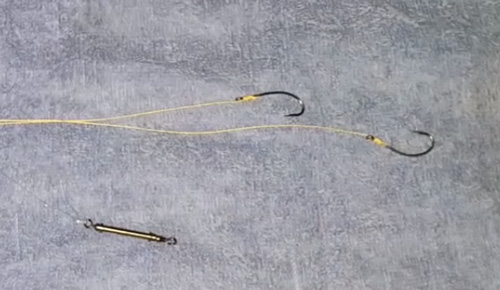
Fly fishing lines are usually tied with two single hooks arranged alternately
The reason you should choose barbless hook sets is that barbed hooks hinder the process of unhooking the fish. In particular, in fishing competitions, using barbless hook sets allows for the fastest possible unhooking.
Fishing line
How should you choose a fishing line?
The second factor to consider once you understand what a float is, is the choice of float line. The choice of float line has a significant impact on your fishing results.
You should opt for a thin, highly transparent monofilament line. When cast into the water, this type of line is virtually invisible to fish, making it much easier to catch them. Furthermore, you should also ensure you choose a fishing line with high strength. As a thin line is used, a high-strength line will minimise the risk of breakage caused by a fish’s sudden pull. Moreover, a high-quality line enhances signal transmission, enabling you to detect a fish taking the bait more quickly and sensitively.

Typically, when tying a float rig, anglers use a double-overlapping knot. This method involves two lines:
- Main line: this is the most important line. The main line runs from the tip of the rod to the lead-wrapping section.
- The leader: the auxiliary line. One end of the leader is tied to the hook, whilst the other is attached to the rubber ring.
The advantage of this method is that once the bait and hook have sunk deep into the water, they move gently on their own, giving the fish the impression that a natural prey is swimming by, making it more likely to take the bait.
What is ‘daï’ bait?
Bait for tower fishing is the next issue anglers need to know about after ‘what is tower fishing?’.
Bait for float fishing comprises two types: live bait and artificial bait.
- Bait for float fishing must be specialised. It usually comes in a wide range of eye-catching colours.
- Bait for creating a feeding ground must be able to create a mist and dissolve. This type of bait plays a key role in creating a feeding ground and attracting fish.
- A handy tip for anglers is to always make the hook bait more appetising than the attractant bait. The reason for this is that if the attractant bait is too tempting, the fish will simply circle around it without taking the bait on the hook.
Which rod should be used for bottom fishing?
Along with ‘What is float fishing? How do you choose a float hook? How do you choose a float line? What is float fishing bait?’, you certainly can’t miss the topic of ‘which rod to use for float fishing’, can you?
You should use a float fishing rod with a length of between 3.6 and 4.5 metres. With a rod of this length, anglers will easily be able to see the float’s signals when a fish takes the bait. This allows for a much more responsive fishing technique.

You can view a range of hand-held float fishing rods here.
As for stiffness, depending on your preferences, you can choose a Taiwanese fishing rod with a stiffness rating ranging from 2H to 8H. Furthermore, anglers will select a rod with the appropriate stiffness based on their budget.
On the market today, Taiwanese fishing rods are available at a wide range of prices, from a few hundred to several million. If you’re interested, you’ll easily be able to purchase a Taiwanese fishing rod to satisfy your passion.
We hope that the useful information we’ve provided on ‘What is float fishing? How do you choose a float hook? How do you choose a float line? What kind of bait is used for float fishing?’ will be of great help to you on your next fishing trip.
Buy fishing tackle at Tuấn Kiệt’s shop on Shopee:

